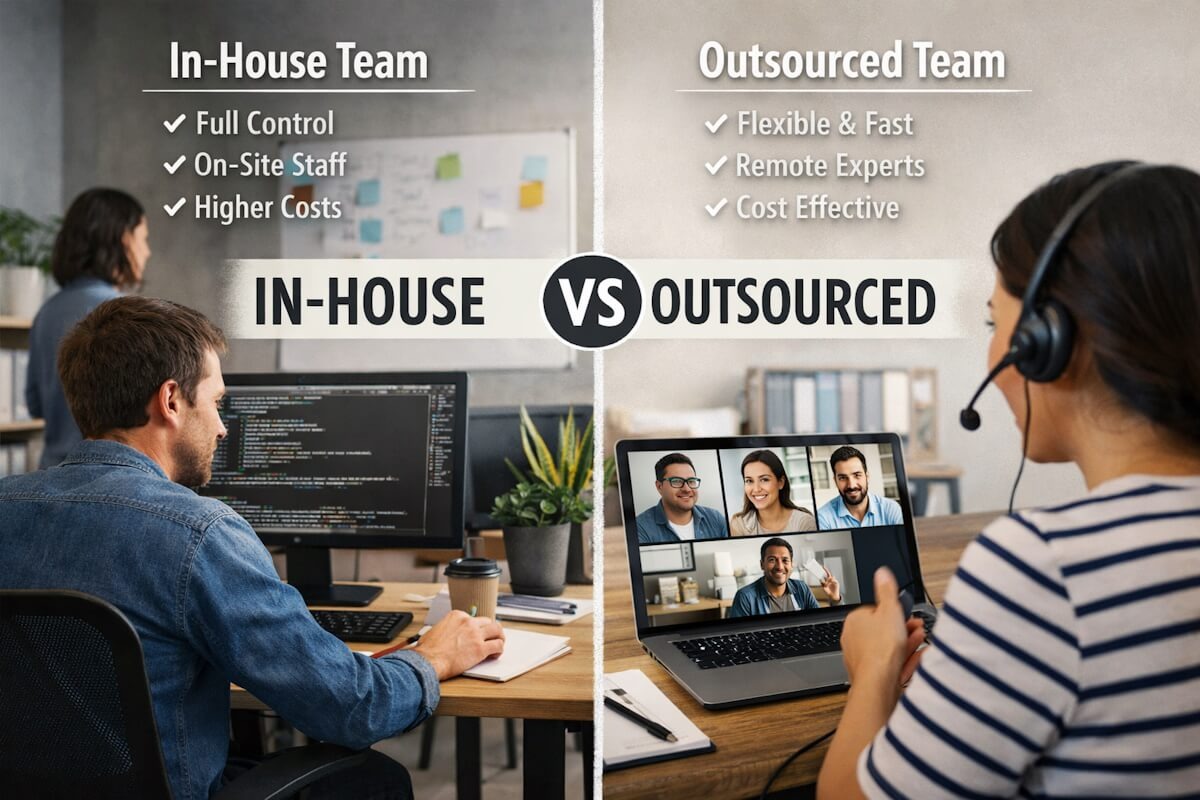
Building software can get complicated real fast. Whether you’re a startup founder sketching your first app idea or an enterprise decision-maker trying to speed up delivery, the question always shows up: should you build your development team in-house or outsource it?
When considering development options, many prefer to build their teams in-house for better control.
In-house teams often provide a deeper understanding of the company culture.
There’s no one-size-fits-all answer. Both models have pros and cons. Some companies prefer tight control and communication that comes with in-house teams. Others are more focused on cost savings, flexibility, or fast access to global talent — the core benefits of outsourcing.
Let’s break it down in plain terms. No fluff, no technical buzzwords. Just what you really need to know to make the right call for your business.
Choosing to develop in-house can lead to better alignment with business goals.
What Does “In-House” Really Mean?
When you invest in an in-house team, you’re investing in your long-term vision.
In-house development also allows for tailored training programs to enhance skills.
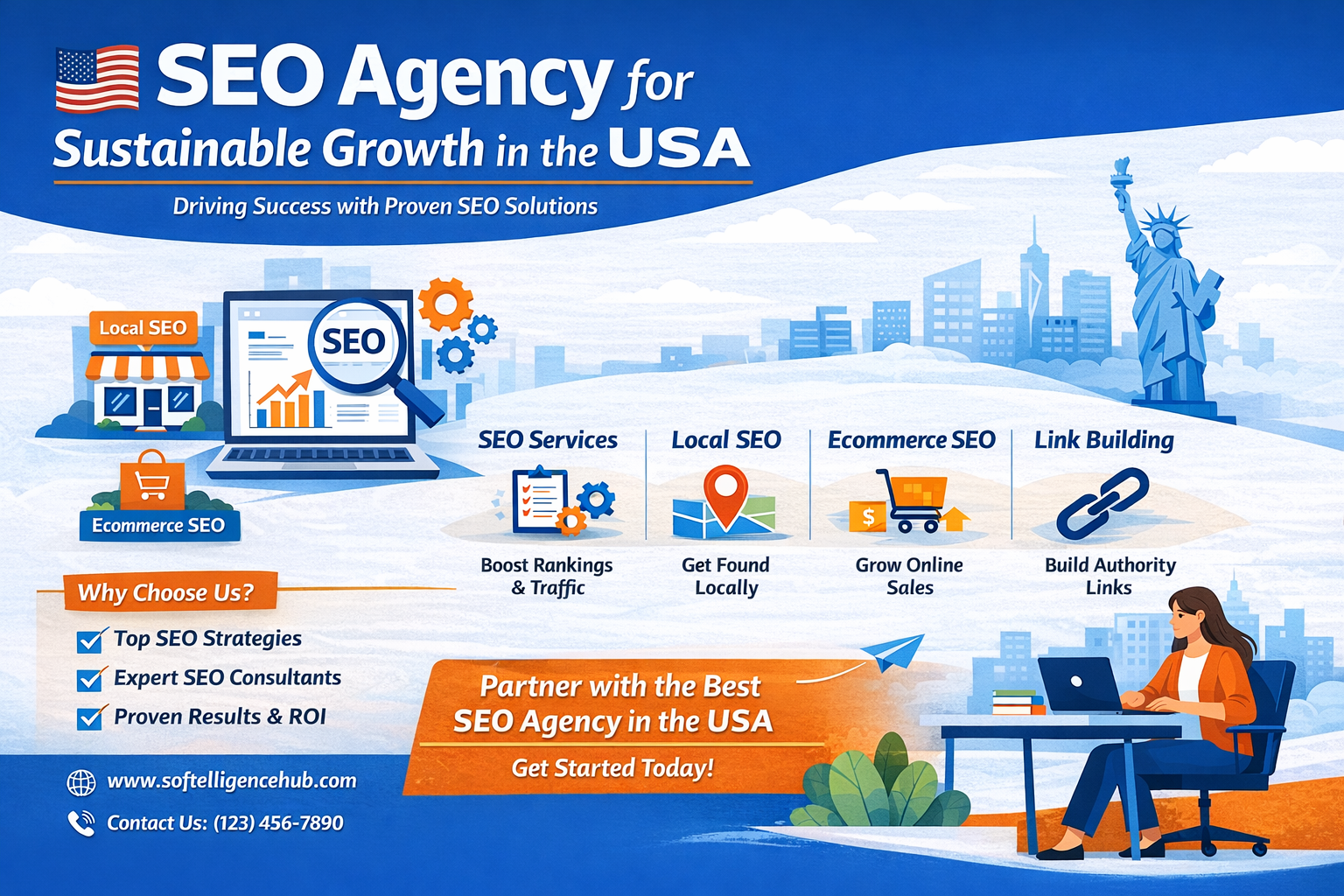
When you build software in-house, your developers are either full-time employees or long-term contractors sitting under your roof (or virtually on your Slack). You manage them directly. You decide the priorities, the pace, and the process. Like SoftelligenceHub SEO services are designed to help businesses improve their online visibility, drive organic traffic, and achieve sustainable search engine rankings. At SoftelligenceHub, the focus is on a strategic, data-driven approach that combines technical SEO, on-page optimization, and high-quality link building to deliver measurable results.
This setup gives you maximum control. You’re the boss. But with that comes all the responsibility — hiring, onboarding, salaries, taxes, benefits, performance management, and team retention.
It’s great when:
- You want tight control over the product
- You’re building core tech and IP
- You need frequent iterations or pivots
- You’ve got the budget and time to build a strong team
So, What’s Outsourced Development Then?
Outsourced development is when you hire an external partner — often a specialized software agency or freelancers — to handle the build. They might take on the full project or work as an extension of your in-house team.
This model is common for businesses that want to stay focused on strategy or operations while letting someone else handle the technical heavy lifting.
It’s useful when:
- You have a fixed timeline and budget
- You need to quickly scale resources
- You lack internal development expertise
- You want faster time-to-market
Team Control vs Speed & Flexibility
One of the biggest differences between these models is how much control you have — and how fast you can move.
In-house teams are part of your company culture. They “get” your vision because they’re living it daily. Communication is smoother. You can walk across the office (or jump on a call) to solve problems in real-time.
But hiring is slow. Good developers are in high demand. It could take months to build the right team, and that’s before you ship anything.
With an in-house team, you have the flexibility to adjust priorities as required.
With outsourcing, you skip the recruitment mess. Need a full-stack developer, UI/UX designer, and QA engineer? A good agency can have them working for you next week. This can be a game-changer if you’re chasing a launch deadline or want to explore something new — like building a mobile app using ChatGPT without forming an AI team in-house.
Let’s Talk Costs
An in-house team can pivot quickly based on immediate needs and feedback.
In-house work fosters strong collaboration and team bonding.
Hiring in-house? Get ready for ongoing costs — salaries, health benefits, retirement plans, workspace, tools, and more. Depending on where you’re based, hiring a single senior developer can cost well into six figures annually.
Outsourcing, on the other hand, is more predictable. Most firms offer fixed-price or hourly contracts. You pay only for the work done. No payroll headaches, no overhead. It’s especially attractive for startups or small businesses that need expert help but can’t commit to full-time salaries.
But here’s a catch — going with the cheapest offshore agency isn’t always smart. Quality varies. Sometimes, you get what you pay for. So, choose partners carefully.
Hiring & Scaling
In-house hiring takes time. First, you define the role. Then there’s sourcing, interviewing, onboarding, and ramp-up. And if a team member quits? Start over. Scaling becomes even harder if you’re trying to build something fast like a cross platform mobile app development project to cover both iOS and Android.
Outsourcing partners can scale up or down based on your needs. Launching a new feature? Add developers. Tight budget next quarter? Reduce hours. You’re not locked in.
That kind of flexibility can keep your business moving even when things get unpredictable.
In-house teams can create a product that truly reflects your brand.
Communication and Collaboration
In-house teams win here. You share the same time zone, often the same office, and maybe even lunch breaks. Misunderstandings are fewer. Changes happen faster.
Outsourced teams? Communication depends on how well your processes are set up. Different time zones, languages, or work styles can cause friction if not handled properly. That’s why it’s essential to work with experienced partners who know how to integrate into your workflow.
Project management tools like Jira, Trello, Slack, and Zoom help bridge the gap — but you’ve got to use them consistently.
Quality Control & Accountability
An in-house team has skin in the game. They’re building something they might maintain for years. That long-term accountability often reflects in the quality of code and attention to detail.
Outsourced teams may not be around forever. That can sometimes mean rushed delivery or shortcuts unless there’s a clear scope, timeline, and post-launch plan in place.
But experienced outsourcing firms often have strong quality checks, documentation practices, and post-delivery support options. It’s all about choosing the right partner.
Security & Intellectual Property
If your app deals with sensitive data, user info, or proprietary logic, you might worry about IP theft or leaks. In-house teams can be easier to monitor, especially if you have strong security policies.
Outsourcing firms usually have NDAs, data protection standards, and secure workflows in place. Still, it’s worth asking about their security measures before you sign anything.
Don’t be shy about this. If they’re handling your code, they should be able to explain how they’ll keep it safe.
Tech Stack & Expertise
In-house teams sometimes get comfortable with a specific tech stack. If your app needs to pivot or use new tools, that can be limiting.
Outsourced teams often work across multiple industries, tech stacks, and use cases. That gives them broader experience and exposure to new tools or ideas. For example, let’s say you’re looking to build a mobile app using ChatGPT — that’s not something every internal team can pull off without significant upskilling. But the right outsourcing partner might’ve already done it.
Long-Term Vision vs Quick Wins
If your product is central to your business — like a SaaS platform or digital product — having in-house devs might be worth the investment. They’ll stick with it long-term, develop deep product knowledge, and grow with the company.
But if you’re testing an idea, exploring a new product line, or building something one-off — like an internal tool or marketing app — outsourcing gives you a faster, lower-risk option.
So, What Should You Choose?
Let’s simplify:
Choose In-House If:
- You want tight control and full-time commitment
- You’re building a long-term product with many iterations
- You can afford the overhead of hiring and retention
Go for Outsourcing If:
- You need to move fast
- You don’t have internal tech talent
- You want predictable costs and scalable teams
- You need specialized skills short-term (e.g., cross platform mobile app development without hiring multiple experts)
In some cases, hybrid teams work best — a core in-house team with outsourced partners filling the gaps. This way, you keep the strategic control but stay flexible.
Still Not Sure?
Start with a small outsourcing project. Test the waters. See how it feels to work with a remote team. Got an idea and want to build fast? Don’t wait 6 months to hire — just Hire Mobile App Developers and get moving.
Over time, you’ll figure out what mix works best for your business. Every company’s different. Your needs, budget, goals — they shape what’s right for you.
Just remember: the goal is to build something valuable. How you do it is up to you.
Smart Choices Make a Big Difference
Don’t overthink it. But don’t wing it either. Whether you build in-house or outsource, what really matters is working with people who care about the end result.
Ultimately, the choice to go in-house is about aligning with your overarching strategy.
So ask questions. Set clear expectations. Track progress. Give feedback. And whether your team’s down the hall or across the world — stay involved.
That’s how you build great software.