Manufacturers face challenges in managing large dealer and distributor networks. Manual operations lead to delays, inaccuracies and low dealer satisfaction. Messages tend to be dispersed in emails and spreadsheets. Onboarding and training take additional resources and time. These problems lower productivity and affect growth.
These problems can be resolved through automation. It establishes a seamless process and decreases documentations as well as strengthens relationships between dealers and manufacturers. Digital-first strategy assists both parties to work smarter and quicker.
The Dynamics 365 Partner Portal provides a powerful solution. It consolidates dealer management, automates the lifecycle, and provides smooth dealer interaction.
Understanding Dealer Lifecycle in Manufacturing
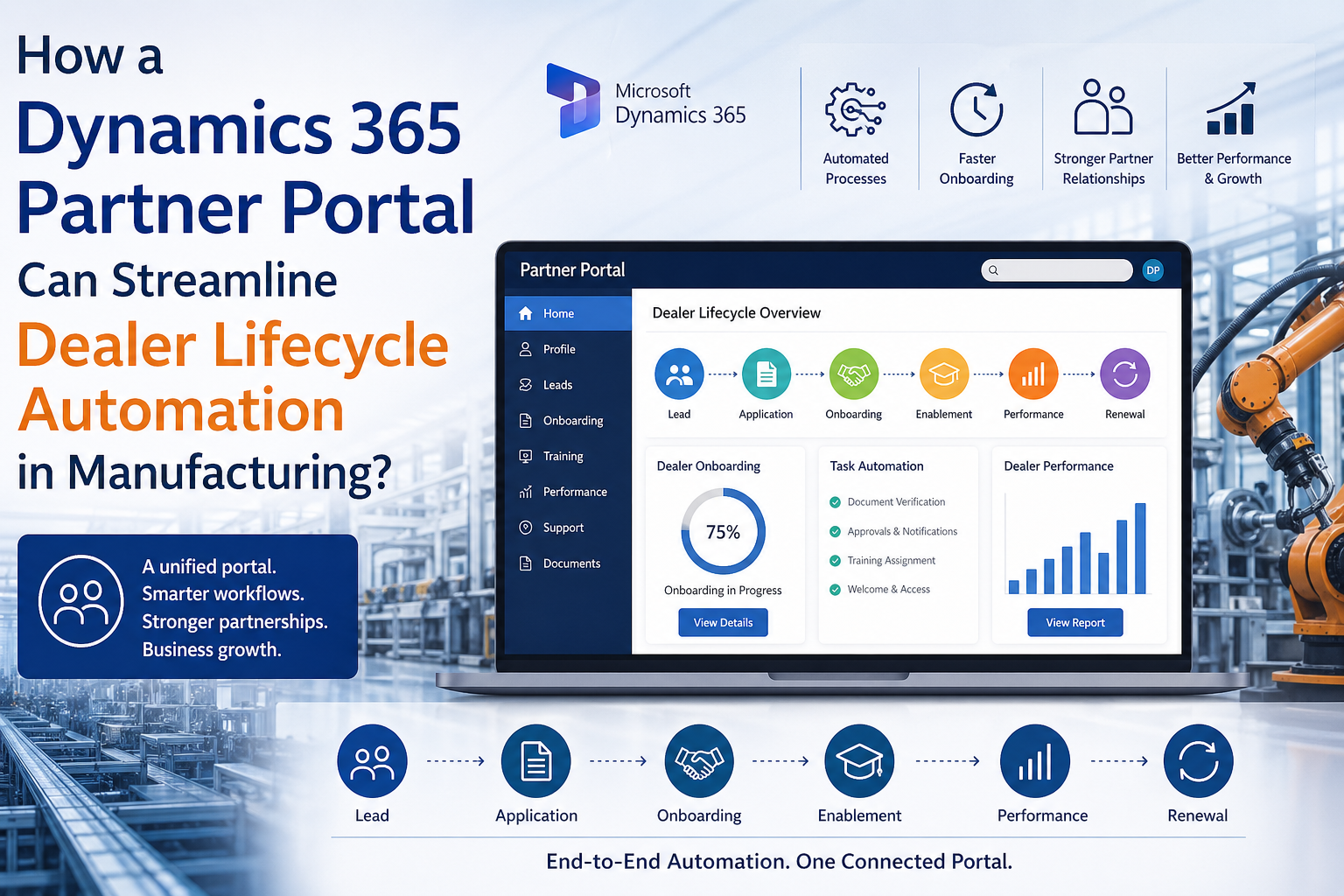
There is a definite path of the dealer lifecycle in manufacturing. It starts with onboarding where the dealers are registered and familiarized with the company policies. Then there is training in which they are taught about the products, systems and ways of selling. This is followed by the order management whereby there is regular buying and stock management.
Performance tracking is also part of the cycle. Manufacturers track dealer sales, targets and incentive performance. Dealers would then need warranty support, claims and problem solving. Lastly, the cycle proceeds to renewal or exit where contracts are renewed or terminated.
This lifecycle can hardly be managed without automation. Manual systems bring delays in approvals and onboarding. There is miscommunication because of the disseminated information. There might be no real-time updating of orders and inventory. Measures of performance are difficult to follow. The result of all this is ineffective dealer engagement and low efficiency. This is where the Dynamics 365 Partner Portal brings real value.
But how does Dynamics 365 Partner Portal help?

Dynamics 365 Partner Portal is compatible with the current business systems. This implies that manufacturers are able to have centralized dealer data, communication and transactions. The portal assists in automating the repetitive tasks and standardising processes. Dealers will have improved visibility and manufacturers will have complete control with one platform. It creates more data-driven and long-term dealer relationships.
Key Ways Dynamics 365 Partner Portal Streamlines Dealer Lifecycle Automation
The dealer lifecycle is very lengthy with onboarding, renewals, etc. All the stages need coordination, communication and promptness. In the absence of automation, manufacturers invest massive efforts in manual repetitive tasks. Dealers also face the problems of delayed approvals, lack of updates and visibility.
The Dynamics 365 Partner Portal changes this completely. It is an end-to-end digital platform in which dealers control their path. Manufacturers achieve improved control, real-time visibility, and improved dealer interaction.
Let’s explore how:
Simplified Dealer Onboarding & Training
Onboarding tends to be manual and slow. With the Dynamics 365 Partner Portal, dealers can self register, upload compliance documents, and complete onboarding digitally. Approvals are done by automated workflows, eliminating delays.
The manufacturers are also able to delegate the guided training modules within the portal. This will make all the dealers ready before they begin their operations, which saves time and resources.
Flawless Communication and Collaboration
Dealer networks rely on strong communication. The portal provides one digital platform where manufacturers communicate news, product updates and promotional campaigns.
The instant alerts and notifications are sent to dealers so that no information is missed. Rather than having emails scattered, the communication remains at one place. This enhances coordination, transparency and trust among dealers and manufacturers.
Automated Order & Inventory Management
Without automation, order management may be complicated. Through the Dynamics 365 Partner Portal, dealers can place orders anytime using a self-service system. The portal links directly to inventory information, thus dealers are aware of inventory availability in real-time.
This prevents excessive orders or delays due to stockouts. The supply chain integration will make the processing faster, precise deliveries, and an improved customer satisfaction.
Dealer Performance Tracking
Dealer performance monitoring assists manufacturers to define goals and enhance performance. The portal has in-built dashboards that monitor KPIs like sales volume, revenue growth, and target accomplishment. Their performance reports are also visible to the dealers and this encourages them to work better.
Manufacturers are able to control incentive schemes better and reward or offer expansion opportunities to the better performing dealers.
Support & Service Automation
Warranty claims, service requests, and technical problems should be supported continuously on the side of dealers. With the Dynamics 365 Partner Portal, they can raise support tickets, access FAQs, or browse a knowledge base 24/7.
Automated routing makes sure that tickets go to the appropriate support team in a short time. This lowers the wait time and enhances dealer satisfaction. The customer service teams also are less burdened by a self-service support system.
Renewals, Compliance and Exit Management
Contracts, licenses, and compliance documents with dealers must be updated on a regular basis. It is not efficient to keep track of such deadlines manually. The portal automates renewal and compliance check reminders so that there is a reduced chance of penalty or missed opportunities.
In case a dealer wants to leave, the portal simplifies the procedure and has transparent workflows and documentation. Manufacturers keep themselves compliant and smooth lifecycle transitions at the end of the lifecycle.
Future of Dealer Lifecycle Automation in Manufacturing
Dealer lifecycle automation will continue to evolve. The use of Artificial Intelligence (AI) will ensure that the interaction with the dealer is more individualized. Dealers will be given customized training, product suggestions and feedback on performance.
Predictive analytics will transform forecasting. Manufacturers can plan production and supply more accurately based on dealer behavior and market trends.
Another advancement is the integration of IoT. IoT sensors on the products will enable manufacturers and dealers to get real-time usage information. This will enhance support services and minimise downtime.
The Dynamics 365 Partner Portal will integrate these technologies to provide even more advanced automation. Early adopters of these solutions will have a competitive advantage as future-ready manufacturers. They will have better dealer relationships, become more efficient in their operations and grow more rapidly.
Conclusion
It is expensive and inefficient to manage dealers manually. The Dynamics 365 Partner Portal changes this by centralizing dealer management, automating processes, and enabling real-time collaboration. Onboarding to renewal, all the steps become easier and transparent.
Automation enables manufacturers to develop better relations with dealers and grow more rapidly. The future will only enhance the demand of AI, IoT and predictive tools in dealer lifecycle management.