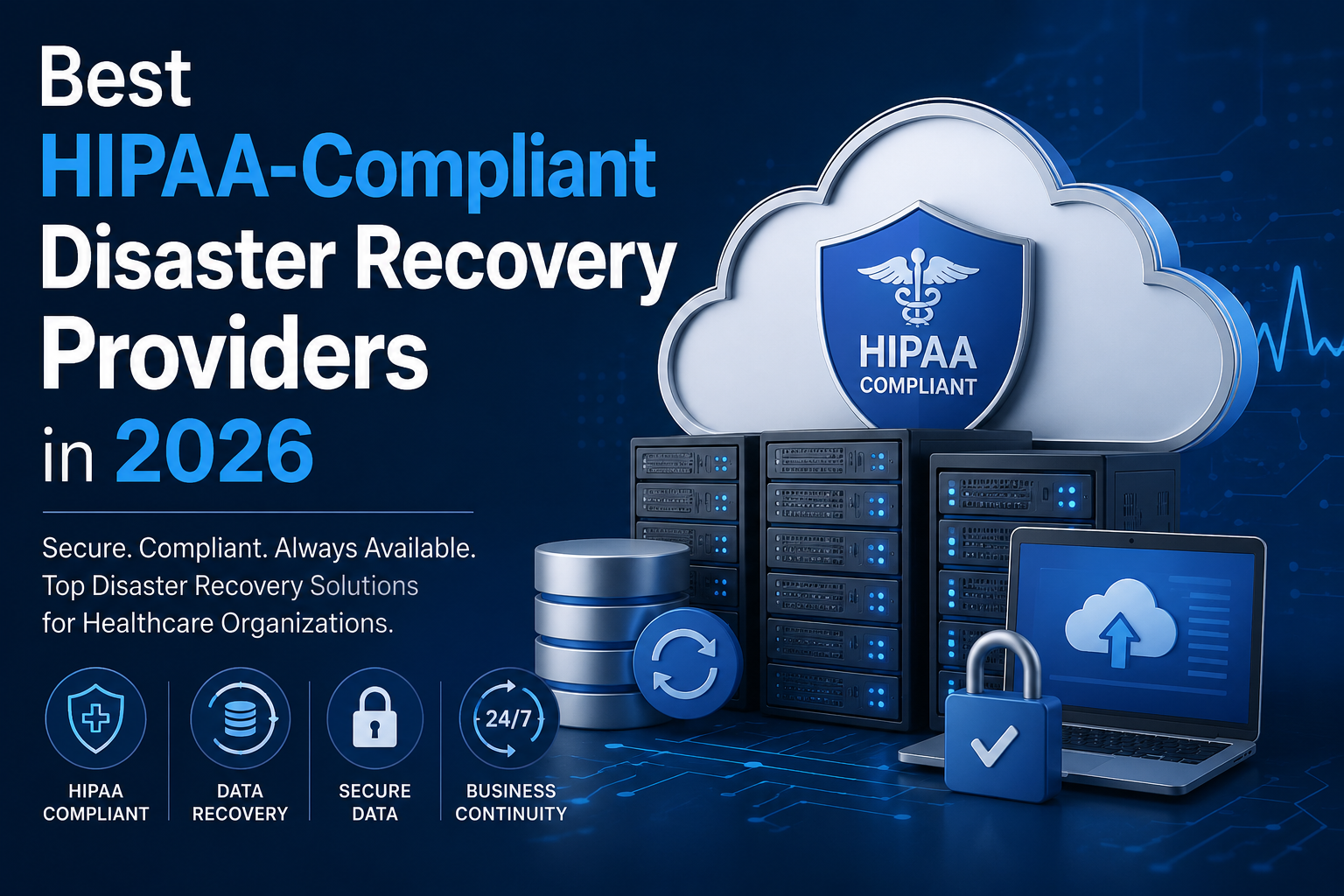
Healthcare data doesn’t get a second chance. When a ransomware attack locks an EHR system, a flood knocks out a data center, or a misconfigured server wipes a patient database, the clock starts ticking on two fronts at once: patient care and regulatory exposure. In 2025 alone, healthcare data breaches exposed hundreds of millions of patient records in the United States, and the average cost of a healthcare breach has climbed well past $4 million globally, with U.S. incidents running even higher. Against that backdrop, disaster recovery (DR) has stopped being an IT afterthought and become one of the most scrutinized parts of a HIPAA compliance program.
This guide breaks down what HIPAA actually requires for disaster recovery, the criteria that separate a genuinely compliant DRaaS (Disaster Recovery as a Service) provider from one that simply claims to be, and a detailed look at the vendors healthcare organizations are relying on in 2026 — from hyperscale clouds to specialized managed DR firms.
Why HIPAA Disaster Recovery Is Different From Ordinary Backup
A common misconception among covered entities and business associates is that having backups automatically satisfies HIPAA. It doesn’t. The HIPAA Security Rule’s contingency planning requirements (45 CFR § 164.308(a)(7)) call for several distinct elements:
- Data Backup Plan — documented procedures to create and maintain retrievable, exact copies of electronic protected health information (ePHI).
- Disaster Recovery Plan — documented procedures to restore any loss of data and bring critical systems back online.
- Emergency Mode Operation Plan — procedures that let critical business processes continue, protecting ePHI, while operating in emergency mode.
- Testing and Revision Procedures — periodic testing of contingency plans, with revisions based on results.
- Applications and Data Criticality Analysis — an assessment of which applications and data are most essential to patient care and operations.
In other words, a nightly backup job is one ingredient, not the whole recipe. HIPAA expects a covered entity to know how fast it can recover (Recovery Time Objective, or RTO), how much data it can afford to lose (Recovery Point Objective, or RPO), and — increasingly relevant in multi-system hospital environments — how consistent recovered systems are with each other (Recovery Consistency Objective, or RCO). An EHR that comes back online out of sync with a lab or pharmacy system can create real clinical risk, not just a compliance headache.
It’s also worth noting that HHS has proposed updates to the HIPAA Security Rule, with a final rule expected sometime in 2026. The proposed changes would make encryption of all ePHI at rest and in transit mandatory rather than “addressable,” and would require multi-factor authentication across systems that touch ePHI. Any DR provider selected in 2026 should already meet these stricter standards, since they’re likely to become enforceable baseline requirements rather than best practices.
1. Amazon Web Services (AWS)
Amazon Web Services (AWS) provides enterprise-grade disaster recovery solutions designed to help healthcare organizations maintain business continuity and protect sensitive patient data. Its highly available global infrastructure, automated failover capabilities, and HIPAA-eligible services make it a trusted choice for organizations requiring secure, scalable, and reliable disaster recovery.
Key Features:
- HIPAA-eligible cloud services
- Multi-region disaster recovery
- Automated failover
- Encrypted storage and backups
- Highly scalable infrastructure
2. Microsoft Azure
Microsoft Azure offers comprehensive disaster recovery and business continuity services through Azure Site Recovery and Azure Backup. Healthcare organizations benefit from automated replication, secure cloud storage, advanced compliance tools, and robust security features that help protect electronic protected health information (ePHI).
Key Features:
- Azure Site Recovery
- Azure Backup
- Built-in HIPAA compliance support
- Data encryption
- Global cloud infrastructure
3. Google Cloud Platform (GCP)
Google Cloud Platform delivers secure cloud infrastructure with disaster recovery capabilities tailored for healthcare organizations. Its resilient architecture, encrypted storage, and automated backup solutions help ensure continuous operations while supporting HIPAA compliance and data protection requirements.
Key Features:
- Secure cloud backups
- Disaster recovery automation
- Encrypted cloud storage
- High availability
- AI-powered cloud services
4. VMware Cloud Disaster Recovery
VMware Cloud Disaster Recovery helps organizations rapidly recover virtual workloads through automated failover, cloud-based recovery orchestration, and immutable snapshots. It enables healthcare providers to minimize downtime while improving resilience against cyberattacks and infrastructure failures.
Key Features:
- Instant workload recovery
- Automated failover
- Immutable snapshots
- Disaster recovery orchestration
- Cloud-based recovery
5. Veeam
Veeam is a leading backup and disaster recovery platform that provides continuous data protection for healthcare organizations. Its fast recovery capabilities, immutable backups, and cloud-native integration help organizations maintain business continuity and protect mission-critical healthcare applications.
Key Features:
- Continuous data protection
- Fast backup recovery
- Immutable backups
- Cloud integration
- Recovery verification
6. Zerto
Zerto specializes in continuous data protection and disaster recovery with near-zero recovery point objectives (RPOs). Its real-time replication and automated failover capabilities help healthcare organizations reduce downtime and maintain uninterrupted access to critical healthcare systems.
Key Features:
- Continuous replication
- Near-zero RPO
- Automated failover
- Recovery testing
- Multi-cloud support
7. Acronis Cyber Protect
Acronis Cyber Protect combines backup, disaster recovery, and cybersecurity into one integrated platform. Healthcare organizations benefit from ransomware protection, encrypted backups, endpoint security, and automated recovery tools that strengthen data protection and regulatory compliance.
Key Features:
- Ransomware protection
- Secure cloud backup
- Endpoint protection
- Automated recovery
- Data encryption
8. Carbonite
Carbonite offers affordable cloud backup and disaster recovery solutions for healthcare providers of all sizes. Its automated backup processes, secure encryption, and quick recovery capabilities help protect electronic health records and minimize operational disruptions.
Key Features:
- Automatic cloud backups
- Secure encryption
- Fast data recovery
- Simple deployment
- Business continuity support
9. Datto
Datto provides business continuity and disaster recovery solutions with hybrid cloud backup, instant virtualization, and automated failover. Its platform enables healthcare organizations to recover quickly from outages while ensuring critical systems remain available during emergencies.
Key Features:
- Hybrid cloud backup
- Instant virtualization
- Automated failover
- Ransomware detection
- Business continuity planning
What Actually Makes a DR Provider “HIPAA-Compliant”
No vendor is HIPAA-compliant out of the box — HIPAA compliance is a shared responsibility between the covered entity and its business associates. That said, some vendors make it dramatically easier to get there than others. When evaluating a provider, look for:
- A signed Business Associate Agreement (BAA). This is non-negotiable. If a vendor won’t sign one, it cannot legally handle ePHI on your behalf, full stop.
- Encryption in transit and at rest, ideally with customer-managed keys or at least transparent key management practices.
- Immutable, air-gapped, or object-locked backup repositories that ransomware cannot encrypt or delete, even with compromised admin credentials.
- Geographic redundancy — data replicated across regions or availability zones so a regional disaster doesn’t take out both production and backup copies simultaneously.
- Granular recovery — the ability to restore a single file, database table, or record instead of rehydrating an entire environment, which shortens RTO significantly.
- Automated backup verification — proof that backups are actually restorable, not just that a backup job completed.
- Audit logging detailed enough to show who accessed or restored PHI, and when, for OCR audit readiness.
- Documented RTO/RPO commitments backed by a service-level agreement, not just marketing language.
- Alignment with recognized frameworks such as HITRUST, NIST 800-53, SOC 2, or FedRAMP, which map cleanly onto HIPAA Security Rule safeguards.
With those criteria in mind, here’s how the major players stack up.
Whichever provider you choose, remember that the vendor relationship is only part of the equation. A signed BAA and a good platform reduce risk, but HIPAA still places the ultimate compliance obligation on the covered entity. That means you still need to independently verify the vendor’s encryption standards, confirm geographic redundancy claims, request evidence of regular recovery testing, and make sure your internal contingency plan documentation — the data backup plan, disaster recovery plan, and emergency mode operation plan — reflects exactly how the vendor’s tools will be used during an actual incident.
A Quick Due-Diligence Checklist Before You Sign
Before finalizing any DR contract, confirm the vendor can produce:
- A signed BAA specific to the services you’ll actually use (not just a generic company-wide BAA that excludes certain products).
- Documentation showing which specific services are HIPAA-eligible, since not every service under a given cloud umbrella qualifies.
- Evidence of immutable or air-gapped backup storage that survives a ransomware event even with compromised credentials.
- A clear RTO/RPO commitment in the SLA, not just in marketing copy.
- Recent third-party audit results (SOC 2 Type II, HITRUST certification, or equivalent).
- A description of how and how often they test failover and recovery — and whether you’re invited to participate in or review those tests.
Final Thoughts
Disaster recovery has become one of the highest-stakes areas of HIPAA compliance, not because the rule itself changed dramatically, but because the cost of getting it wrong — in breach fines, OCR scrutiny, and disrupted patient care — has risen sharply. The good news is that the market has matured alongside the risk: whether you need hyperscaler-level flexibility, a fully managed service with audit-ready documentation, or a cloud-native platform built for multi-cloud healthcare environments, there’s a mature, HIPAA-capable option available in 2026. The work now is less about finding a vendor willing to sign a BAA, and more about verifying, testing, and documenting that the recovery plan you’ve built with them will actually work the day you need it.