Bare metal servers remain the gold standard for businesses that demand maximum performance, full hardware control, and predictable workloads. Unlike virtualized environments, bare metal solutions eliminate the hypervisor layer, delivering dedicated resources ideal for high-performance computing, databases, AI/ML, and large-scale enterprise applications.
In 2026, providers are competing on network speed, global reach, automation, and pricing flexibility. Below are the top 10 bare metal server providers, presented in the same structured format you requested.
1. Amazon Web Services (AWS) — Bare Metal Servers
Amazon Web Services (AWS) offers bare metal servers that give businesses full access to physical hardware without a hypervisor. These dedicated instances are deeply integrated with the AWS ecosystem, delivering performance, security, and global scale.
Features & Use Cases:
AWS provides flexible bare metal instance types with customizable CPU, memory, and networking options. Ideal for high‑performance computing (HPC), large databases, AI/ML workloads, analytics, and enterprise applications requiring consistent and predictable performance.
- Pricing: Pay‑as‑you‑go with on‑demand billing and reserved options for cost savings.
- Availability: Multiple regions across the Americas, Europe, Asia Pacific, and Middle East.
- Best For: Enterprise workloads, high compute demands, hybrid cloud adoption.
Feature Analysis Assessment:
| Feature | Assessment |
|---|---|
| Performance | Excellent |
| Price | Competitive at scale |
| Provisioning Speed | Fast automation |
| Instance Variety | Broad ecosystem |
| Management Complexity | Moderate |
Pros:
- Deep integration with AWS services and tools
- High scalability and reliability
- Strong security and compliance support
Cons:
- Pricing complexity
- Can be overwhelming for beginners
2. openmetal.io
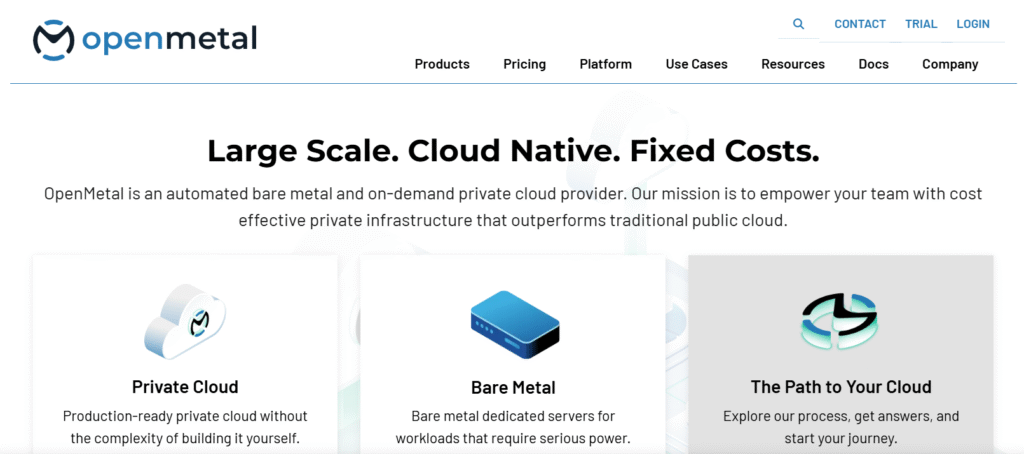
OpenMetal provides high-performance bare metal cloud infrastructure designed for businesses that need dedicated hardware with the flexibility of cloud provisioning. Built with an open-source-first approach, OpenMetal focuses on delivering predictable performance, transparency, and full control without vendor lock-in.
Features & Use Cases:
OpenMetal offers on-demand bare metal servers with automated deployment, allowing users to spin up physical machines in minutes. Their infrastructure is optimized for private cloud environments, especially for deploying OpenStack clusters. It’s ideal for high-performance applications, SaaS platforms, edge computing, and organizations that require full hardware control with cloud-like agility.
Pricing:
Simple, transparent monthly pricing with no hidden fees. Fixed-cost plans make budgeting easier compared to variable cloud billing models.
Availability:
Data centers primarily in North America and Europe, with expansion options depending on demand.
Best For:
Private cloud deployments, OpenStack users, developers needing dedicated infrastructure, and businesses avoiding hyperscaler lock-in.
| Feature | Assessment |
|---|---|
| Performance | Excellent |
| Price | Transparent |
| Provisioning Speed | Fast |
| Instance Variety | Moderate |
| Management Complexity | Moderate |
Pros:
- True bare metal performance with no virtualization overhead
- Transparent and predictable pricing
- Strong support for OpenStack and private cloud setups
- Fast provisioning with automation
Cons:
- Fewer global data centers compared to hyperscalers
- Smaller ecosystem than major cloud providers
- Limited managed services compared to AWS or Azure
3. Atlantic.Net
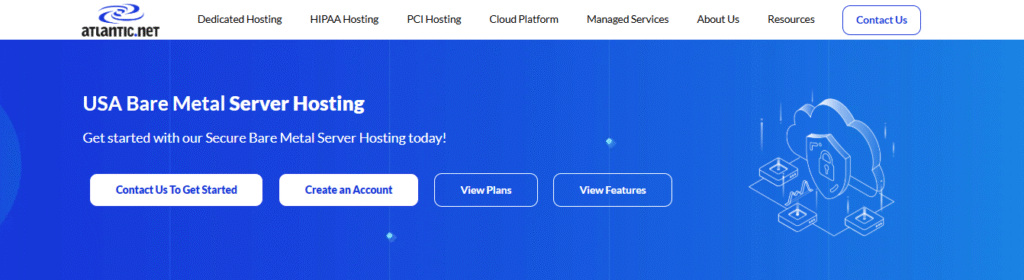
Atlantic.Net has offered hosting services for over 30 years, focusing on stable, high-performance bare metal hosting infrastructure in the USA. The platform’s simple pricing makes it easy to plan your costs. It’s a solid option for businesses that need reliable uptime, secure environments, and fast, knowledgeable support.
The dedicated bare metal servers run on NVMe SSD storage in RAID 10, giving you fast disk performance with data redundancy. The platform also supports compliance requirements such as HIPAA and PCI, which makes it suitable for regulated workloads.
Pricing: Fortress Standard start at $873.28/month
Key features:
Highly customized secure dedicated bare metal hosting in USA backed by NVMe SSD storage with RAID 10, 100% uptime SLA, 24/7 U.S.-based phone support, optional managed services, and GPU and high-core server options.
Pricing: Fixed monthly rates with usage tiers; competitive for secure workloads.
Availability: Global data centers across key enterprise regions in the USA.
Best For: Secure and Compliant Hosting.
Feature Analysis Assessment:
| Feature | Assessment |
| Performance | Excellent |
| Price | Good value for function |
| Provisioning Speed | Moderate |
| Instance Variety | Strong |
| Management Complexity | Moderate |
Pros:
- Strong focus on security and compliance
- Consistent performance under load
- Fast setup with minimal wait time
- Real, U.S.-based support you can call
- Flexible setup for growing workloads
Cons:
- Data centers are not available in Europe
Best suited for:
Businesses, healthcare teams, financial services, and developers who need secure, reliable, dedicated bare metal hosting with hands-on support.
4. IBM Cloud — Bare Metal Servers
IBM Cloud offers fully dedicated bare metal servers designed for enterprise environments where performance, customization, and security are top priorities.
Features & Use Cases:
Highly customizable servers with dedicated CPU, RAM, and storage options. Best for large databases, AI workloads, blockchain, and regulated industries needing robust compliance.
- Pricing: Fixed monthly rates with usage tiers; competitive for long‑running workloads.
- Availability: Global data centers across key enterprise regions.
- Best For: Mission‑critical enterprise applications.
Feature Analysis Assessment:
| Feature | Assessment |
|---|---|
| Performance | Excellent |
| Price | Good value for function |
| Provisioning Speed | Moderate |
| Instance Variety | Strong |
| Management Complexity | Moderate |
Pros:
- Enterprise‑grade security and compliance
- High compute customization
- Strong hybrid cloud support
Cons:
- Provisioning can be slower than competitors
- Less ecosystem breadth compared to AWS/GCP
5. Microsoft Azure — Bare Metal
Overview:
Azure Bare Metal delivers dedicated compute servers with full hardware control while maintaining deep integration with Azure cloud services.
Features & Use Cases:
Ideal for hybrid cloud environments, AI, containerized workloads, and enterprise apps. Azure’s bare metal offering can connect seamlessly with Azure Arc and other management tools.
- Pricing: Consumption‑based with enterprise discounts.
- Availability: Widely available across global Azure regions.
- Best For: Hybrid enterprises, Windows workloads.
Feature Analysis Assessment:
| Feature | Assessment |
|---|---|
| Performance | Excellent |
| Price | Competitive |
| Provisioning Speed | Fast |
| Instance Variety | Strong |
| Management Complexity | Moderate |
Pros:
- Rich tooling and integration
- Hybrid cloud leader
- Strong enterprise support
Cons:
- Complex pricing tiers
- Slight learning curve for hybrid setups
6. Equinix Metal
Overview:
Equinix Metal provides instantly provisioned, automated bare metal infrastructure with true global reach across Equinix data centers.
Features & Use Cases:
Supports edge computing, low‑latency networking, hybrid deployments, and cloud integration. Offers connectivity to major cloud providers and peering ecosystems.
- Pricing: Transparent usage‑based pricing with volume discounts.
- Availability: Extensive global footprint with carrier‑neutral access.
- Best For: Edge workloads, hybrid architectures.
Feature Analysis Assessment:
| Feature | Assessment |
|---|---|
| Performance | Excellent |
| Price | Mid‑range |
| Provisioning Speed | Instant |
| Instance Variety | Moderate |
| Management Complexity | Easy |
Pros:
- Instant provisioning
- Strong global connectivity
- Great for edge use‑cases
Cons:
- Fewer CPU/GPU options than hyperscalers
- Not as integrated with major cloud services
7. OVHcloud — Bare Metal Servers
Overview:
OVHcloud offers a broad range of cost‑effective bare metal servers with dedicated resources and customizable configurations.
Features & Use Cases:
Excellent balance of price and performance for web hosting, databases, and SaaS applications. Includes advanced anti‑DDoS protection and IPv4/IPv6 support.
- Pricing: Very competitive, fixed cost model.
- Availability: Europe, North America, Asia Pacific.
- Best For: SMBs, web hosting, value‑oriented workloads.
Feature Analysis Assessment:
| Feature | Assessment |
|---|---|
| Performance | Strong |
| Price | Very Competitive |
| Provisioning Speed | Fast |
| Instance Variety | Wide |
| Management Complexity | Easy |
Pros:
- Great price‑to‑performance ratio
- Simple cost models
- Solid hardware options
Cons:
- Fewer advanced integrations
- Limited enterprise tooling
8. Hetzner Dedicated & Bare Metal Servers
Overview:
Hetzner delivers high‑performance dedicated hardware at some of the most competitive prices in the industry, ideal for startups and scale‑ups.
Features & Use Cases:
Reliable servers with high bandwidth, customizable hardware, and strong storage options. Suitable for hosting, analytics, databases, and gaming servers.
- Pricing: Extremely affordable; flat monthly fees.
- Availability: Europe‑centric data centers.
- Best For: Cost‑sensitive workloads.
Feature Analysis Assessment:
| Feature | Assessment |
|---|---|
| Performance | Solid |
| Price | Excellent |
| Provisioning Speed | Fast |
| Instance Variety | Moderate |
| Management Complexity | Easy |
Pros:
- Unbeatable pricing
- Strong performance for cost
- Simple setup
Cons:
- Limited geographic reach
- Basic enterprise tooling
9. Liquid Web — Bare Metal Servers
Overview:
Liquid Web specializes in managed bare metal servers with high performance, reliability, and expert support.
Features & Use Cases:
Great for e‑commerce platforms, SaaS apps, and high‑traffic sites. Includes managed services options, robust monitoring, and premium support.
- Pricing: Higher tier with premium support included.
- Availability: US and Europe data centers.
- Best For: Managed mission‑critical apps.
Feature Analysis Assessment:
| Feature | Assessment |
|---|---|
| Performance | Strong |
| Price | Premium |
| Provisioning Speed | Moderate |
| Instance Variety | Good |
| Management Complexity | Easy (managed) |
Pros:
- Excellent support
- Managed services included
- Reliable infrastructure
Cons:
- More expensive
- Less DIY flexibility
10. Scaleway Elastic Metal
Overview:
Scaleway Elastic Metal offers instant bare metal servers with flexible configurations optimized for compute‑intensive applications.
Features & Use Cases:
Supports AI, analytics, and enterprise web platforms. Offers integration with Scaleway cloud services for hybrid deployments and elastic scaling.
- Pricing: Competitive usage‑based rates.
- Availability: Europe primarily.
- Best For: Elastic workloads and hybrid cloud setups.
Feature Analysis Assessment:
| Feature | Assessment |
|---|---|
| Performance | Excellent |
| Price | Competitive |
| Provisioning Speed | Fast |
| Instance Variety | Moderate |
| Management Complexity | Moderate |
Pros:
- Fast provisioning
- Strong performance per cost
- Good hybrid capabilities
Cons:
- Limited global footprint
- Fewer enterprise integrations
11. Oracle Cloud Infrastructure (OCI) — Bare Metal Compute
Overview:
OCI offers high‑performance bare metal servers optimized for database, analytics, and enterprise compute workloads.
Features & Use Cases:
Flexible shapes with customizable CPU and GPU options. High‑performance networking and local NVMe storage make it ideal for HPC, databases, and AI.
- Pricing: Pay‑as‑you‑go with competitive high‑end rates.
- Availability: Growing global enterprise footprint.
- Best For: Databases, AI workloads, high‑performance computing.
Feature Analysis Assessment:
| Feature | Assessment |
|---|---|
| Performance | Excellent |
| Price | Competitive |
| Provisioning Speed | Fast automated deployment |
| Instance Variety | Strong |
| Management Complexity | Moderate |
Pros:
- Excellent price‑to‑performance
- High network throughput
- Strong database support
Cons:
- Smaller ecosystem than hyperscalers
- Pricing can be complex
Key Points to Consider in 2026
When choosing a bare metal provider, focus on:
- Performance requirements (CPU, GPU, NVMe)
- Network throughput and latency
- Global data center presence
- Automation and API capabilities
- Pricing model (hourly vs monthly)
- Support quality
Conclusion
Bare metal servers in 2026 are more flexible and automated than ever.
- Best for enterprise performance: OCI, AWS, IBM
- Best for developers and automation: Equinix Metal, Scaleway
- Best budget options: OVHcloud, Hetzner
- Best managed experience: Liquid Web
The right choice ultimately depends on your workload type, budget, and required geographic coverage. For database-heavy and HPC workloads, premium hyperscalers lead the pack, while cost-conscious users can achieve excellent value from European providers.
Comments
3 responses to “Best Bare Metal Server Provider Options for 2026”
[…] this guide, we highlight the top HIPAA-compliant hosting providers in 2026 based on security, reliability, scalability, compliance readiness, and healthcare-focused […]
[…] is a French hyperscale cloud provider that also offers highly affordable bare metal dedicated servers across four continents. They own their data centers and manufacture their own server hardware, which […]
[…] enterprise cloud AI […]