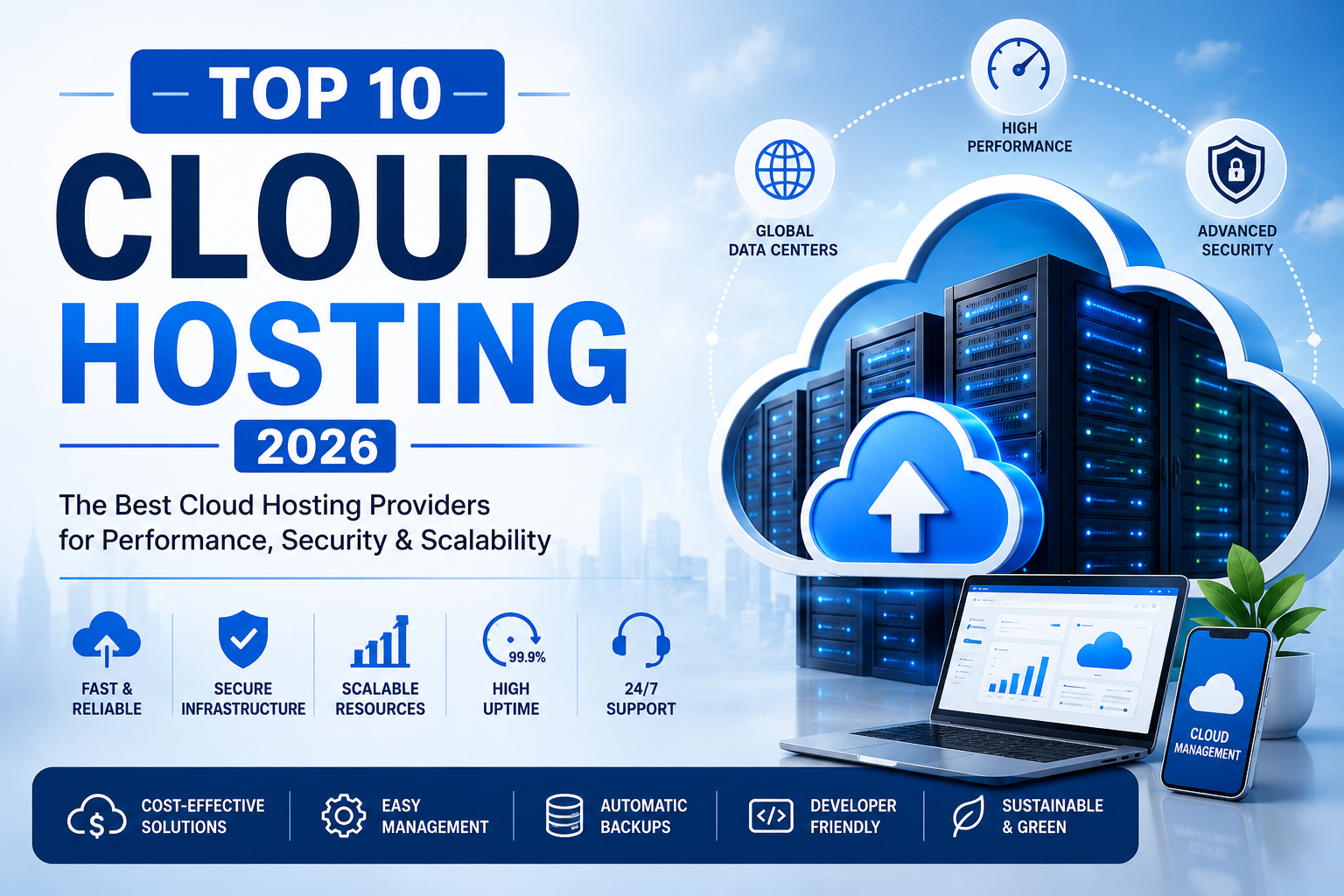
Top 10 Cloud Hosting Services in 2026
Ten providers, run through the same checklist: compute, pricing honesty, support, and how far each one gets you before you need a bigger team to run it. No sponsored slot on this manifest.
Article overview: “Cloud hosting” now spans three very different things — hyperscale platforms (AWS, Google Cloud, Azure) with hundreds of services and enterprise-grade compliance; independent clouds (DigitalOcean, Vultr, Linode/Akamai) built around simple, flat-rate virtual machines; and managed layers (Cloudways) that sit on top of raw infrastructure so you don’t have to run it by hand. This list covers all three, ranked by how well each one balances power against how much runway you need to actually use it.
Every entry below includes what it’s built for, what it costs to start, and where it starts to strain. Pricing is shown as a starting point, not a guaranteed final bill — cloud pricing moves fast, so treat the numbers as a baseline for comparison and confirm current rates before you commit a budget.
Key points before you pick one
- Hyperscalers (AWS, Azure, GCP) win on breadth and compliance, not on ease or predictable pricing.
- Independent clouds (DigitalOcean, Vultr, Linode) are the cheapest way to get a real VM running today.
- Managed platforms like Cloudways add a markup in exchange for not having to SSH in at 2am.
- Entry-level pricing is rarely the real bill — bandwidth, backups, and storage add up fast everywhere.
- The “best” provider changes depending on team size, not just workload — factor in who’s on call.
AWS is still the default answer for “which cloud” — the largest service catalog, the deepest bench of regions, and the platform most enterprise compliance teams already know how to audit. EC2, S3, RDS, and Lambda cover almost any workload shape, and the free tier is a genuine way to learn the platform before spending real money.
Nominal
- Unmatched service breadth and region count
- Deep compliance and enterprise tooling
Advisory
- Pricing is genuinely hard to predict upfront
- Steep learning curve for a first deploy
Strongest where data and AI/ML workloads meet infrastructure — BigQuery, Vertex AI, and GKE are genuinely best-in-class, and per-second billing on Compute Engine is friendlier to short-lived jobs than most rivals. The console and docs are also a noticeably easier on-ramp than AWS for a first-time cloud team.
Nominal
- Best-in-class data, analytics, and AI tooling
- Per-second billing, sustained-use discounts
Advisory
- Smaller service catalog than AWS
- Some regions and services still catching up
The obvious pick if your company already runs on Microsoft — Active Directory, Microsoft 365, and .NET workloads integrate tightly, and Azure’s hybrid-cloud story (Azure Arc, Azure Stack) is stronger than AWS’s or GCP’s for organizations that still keep servers on-site.
Nominal
- Deep Microsoft ecosystem integration
- Strong hybrid-cloud and enterprise agreements
Advisory
- Console can feel inconsistent across services
- Pricing calculator often undercounts real cost
DigitalOcean is what most developers picture when they hear “spin up a server” — Droplets with per-second billing, flat monthly caps, and a dashboard you can actually learn in an afternoon. App Platform adds a Heroku-like path for teams that don’t want to touch a VM at all.
Nominal
- Simple, predictable, flat-rate pricing
- Excellent docs and developer experience
Advisory
- Smaller service catalog than the hyperscalers
- Fewer regions than AWS or GCP
Vultr’s edge is geography and honesty about hourly billing — 30+ data centers, transparent per-hour rates, and a compute lineup (Regular, High Performance, High Frequency, VX1) that scales cleanly from a $2.50/mo test box to production-grade instances that go toe-to-toe with hyperscaler pricing.
Nominal
- Very low entry price, transparent hourly billing
- Wide global data center footprint
Advisory
- Bandwidth is metered per-server, not pooled
- Support reputation trails DigitalOcean’s
Now sold as Akamai Cloud Computing, Linode kept its flat-rate simplicity after the acquisition and gained Akamai’s global network and a fast-expanding GPU catalog on top. Shared-CPU plans are plainly priced, and pooled outbound transfer makes multi-server budgets easier to predict than Vultr’s.
Nominal
- Flat, predictable pricing with pooled transfer
- Akamai’s network reach and new GPU lineup
Advisory
- Brand transition still causing some confusion
- Dedicated CPU tiers cost more than rivals
Europe’s largest independent cloud, and the go-to for teams that need EU data residency without the compliance overhead of a hyperscaler. Dedicated servers, vRack network segmentation, and anti-DDoS come standard, and pricing stays noticeably lower than AWS or Azure at comparable specs.
Nominal
- Strong EU data residency and GDPR posture
- Affordable dedicated servers with DDoS included
Advisory
- Support response times trail US-based rivals
- Console and docs feel less polished
OCI’s pitch is a genuinely generous Always Free tier and pricing that undercuts AWS/Azure/GCP on comparable compute — plus the deepest bench for Oracle Database workloads migrating off on-prem hardware. Less of a natural fit outside Oracle-centric or database-heavy shops.
Nominal
- Aggressive pricing, generous always-free tier
- Best-in-class for Oracle Database workloads
Advisory
- Smaller third-party ecosystem and community
- Less intuitive outside core Oracle workloads
IBM’s cloud leans hard into hybrid deployments and regulated industries — banking, government, and healthcare workloads via IBM Cloud for Financial Services, plus tight integration with Red Hat OpenShift for teams standardizing on Kubernetes across on-prem and cloud.
Nominal
- Strong regulated-industry compliance tooling
- Deep Red Hat OpenShift integration
Advisory
- Smaller community and slower feature velocity
- Documentation can lag behind current products
Cloudways sits on top of DigitalOcean, Vultr, Linode, AWS, and Google Cloud, adding a managed layer — patching, backups, caching, a real support team — for a markup over raw infrastructure pricing. It’s the practical middle ground between a bare VPS and a fully managed WordPress host.
Nominal
- Managed security, backups, and support included
- Switch underlying cloud provider without migrating
Advisory
- 20–40% markup over the raw infrastructure cost
- No built-in email hosting or domain registration